
WHAT IS ASPECT MANAGEMENT?
Information management, for the way AI reads.
AI changed what search can be, and people changed how they search. The way information is organised did not change with it. So search became a black box, and the AI took control. Aspect management changes the root cause, so your organisation controls its AI, instead of the AI controlling you.
DEFINITION
Aspect management is the practice of organising information for AI: a layer between your content and your search that combines content, metadata and context into aspects, one weighed fingerprint per document. Search and AI run on top of it, and people steer what counts.
WHY IT IS NEEDED
AI changed what search can be. Search couldn't follow.
AI made a different kind of search and retrieval possible: it understands intent, reads, and answers. People followed. Search did not, and not because search engineers failed. It is because of the way information is organised. Follow the chain.
01 →
AI changed what is possible
A different kind of search and retrieval: it understands intent, reads, and answers.
02 →
People followed
They ask in plain language and expect an answer, at home and at work.
03 →
AI needs search
Without enterprise information, an assistant can only guess.
04 →
Search needs information
It can only find what is there, in the way it is stored.
05 →
Information is organised for people
Content, metadata and context in three places, each with its own search.
06
So search is forced to patch
Three searches, rules of thumb and a reranker to merge the results.
Because of the way information is organised, search
has become a black box.
One score comes out at the end, and nobody can explain how it got there. If you cannot see why the AI
picked a document, you cannot steer it. You can only accept the answer or check it yourself. The AI is in
control of the organisation, instead of the other way around.
Change the root cause, and you control AI, instead of AI controlling you.
HOW INFORMATION IS ORGANISED TODAY
Three places, three searches. The silo we never saw.
We spent thirty years fighting silos between systems. But every system also keeps a document's information in three places: the content (what it says), the metadata (what we know about it) and the context (how it connects). Each has its own search.
An experienced colleague joins the three in their head. AI searches three times, merges the results with rules of thumb, then checks. Not sure? It searches again and checks again. Every check is an LLM call.
Copilot isn't slow. It's checking.
THEN AI ARRIVED
The patches piled up. None of them finish.
Hybrid search
Keyword and vector results, mixed with a rule of thumb.
Metadata filters
Bolted on: in or out, never weighed.
Knowledge graphs
Built to add the missing context, as yet another search.
Rerankers
Re-sort the merged results, with one score nobody can explain.
Business rules
Written before the question is asked, while the right answer depends on the question.
“Clean your content first”
A project without an end date, now that AI writes most new versions.
Every patch adds another layer to the black box. And the most common advice treats the wrong problem: our information is not too dirty for AI, it is organised for people.
AI-ready data isn't clean data. It's aspected data.
The problem was never the quality of your data. It is the silo we never saw: content, metadata and context kept apart, and joined only in people's heads.
THE ROOT CAUSE, CHANGED: ASPECTS
One dimension of what makes a document the right one.
Its meaning, its type, its version, its status, the product or case it belongs to. Together, a document's aspects form its fingerprint. The question is turned into aspects too, so the intent of the question is carried into the search. Then math, not another round of LLM calls, weighs how close they are.
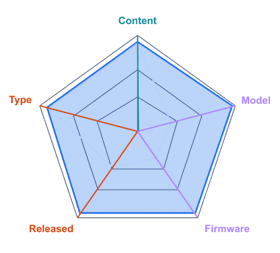
Aspects
An engineer types: “Printer P7 shows error 49 after the update.” Ten bulletins mention error 49. Only one is for the P7, for the new firmware, and released. It matches the question on every aspect. A similar one falls away on model and firmware.
Weighed, not filtered
Metadata says in or out. Aspects say how much each dimension counts. Last week is close to yesterday; a year ago is far. A score, not a hard rule.
Every aspect keeps its own score
Instead of one number nobody can explain, you see exactly why a document came first, aspect by aspect.
No fields to fill in
Ask the way you ask any AI chat. The model number and “after the update” become aspects of the question. You get the precision of advanced search.
A new layer between your content and your search.
Aspects are an index, and an index belongs at the data level. Aspect management sits between your content and everything that reads it. Your content stays where it is; search and AI run on top. Think of it as middleware, but for information.
An additional index, not an additional search.
Your search on top
Your existing search uses the aspects to weigh what it finds, in the place where a reranker or extra LLM calls sit today.
Aspect search on top
The question is turned into aspects and goes straight to the universal index. One search weighs all three at once.
Applications on top
Builders create knowledge agents and assistants on the same aspects and the same governance, connected over MCP.
Five things you can't do today.
WHO OWNS IT
Someone has to own what your AI reads.
Deciding which aspects matter, keeping them current, setting the weights, governing what gets out: that is information management, applied to AI. The people who have always cared about what information means, where it belongs and who may see it are the ones best placed to do it. Aspect management is how an organisation takes back control of its AI.
Collaboration management
SharePoint and similar. To collaborate.
Enterprise content management
Workflow and compliant storage. To comply.
Aspect management
Quality control for what AI reads. To control your AI.
Questions people ask
Does it replace my search?
No. It is an additional index, not an additional search. Your existing search can run on it, aspect search can run on it, or both.
Do I need to clean my content first?
No. AI-ready data isn't clean data; it's aspected data. Aspects weigh versions, status and context, so the right document comes first even when copies exist. Cleaning becomes a choice.
Do I need to migrate?
No. Your content stays where it is. Aspects work across SharePoint, ECM and file shares.
How is this different from metadata management?
Metadata management keeps fields correct and uses them as filters. Aspect management combines metadata with content and context, and weighs them instead of filtering.
Does it work with Copilot and other assistants?
Yes. Your AI connects over MCP. It gets fewer, better candidates and needs fewer LLM calls to check them.
Is aspect management a product?
It is a discipline. Aspected builds the tools for it: aspect search on the patented Aspected Database, and the Aspect Management System to manage it.
See aspect management on your own content.
Start with a near-duplicate analysis of your SharePoint: how many versions of each document your AI finds, and which one is most likely the record.
Or write to sales@aspected.com
Read “The silo we never saw” on AIIM