
Share this
by Aran Montero Salvadó on Mar 9, 2026, 9:00:00 AM
How AI-generated metadata is reshaping enterprise retrieval and turning enriched metadata into a core component of relevance.
TL;DR
Most retrieval problems attributed to AI models are actually relevance problems. While AI-driven metadata enrichment has improved how systems describe documents, retrieval architectures still rely on hard filters and heuristic ranking that cannot fully exploit this enriched information. Aspect Search introduces a different retrieval primitive, where relevance is calculated across multiple semantic aspects, including enriched metadata, directly in vector space. This shifts retrieval from rigid filtering to unified, multi-dimensional similarity computation that better reflects real-world context and user intent.
From Data Chaos to Structured Intelligence
Enterprise systems today manage increasingly large and heterogeneous collections of digital documents, including reports, contracts, emails, and multimedia content. As these collections expand, a central challenge emerges: how can we effectively organize, retrieve, and understand information? Metadata is connected to many of these approaches, but its role has historically been limited.
Traditionally, metadata has been primarily used to support operational concerns such as filtering, access control, regulatory compliance, and document management systems. While effective for these purposes, it has rarely been treated as a core input to relevance computation in search and retrieval workflows.
At the same time, information retrieval systems have largely focused on textual content as the primary source of meaning. Full-text search engines and the more recent semantic search systems have usually treated metadata as auxiliary information, applying it as pre-retrieval constraints or post-retrieval filters to narrow result sets, enforce policies, or improve precision. In this model, meaning is computed in vector space, while context is applied externally.
Metadata is useful, but this information is often limited in scope and variable in quality. The goal of metadata enrichment is to overcome these limitations by applying AI techniques to extract additional properties that are not explicitly present in the original document.
With the rise of AI, there is renewed interest in extracting deeper insights from documents beyond their raw text by generating richer metadata. This shift has made metadata enrichment a critical capability, enabling systems to infer, generate, and refine document attributes automatically. Rather than being static, metadata can now be dynamically derived, contextual, and adaptive, as demonstrated in large-scale semantic enrichment initiatives in both industry and the public sector [1].
Modern metadata enrichment pipelines rely on advances in natural language processing and machine learning. Transformer-based models and large language models (LLMs) have demonstrated strong performance in extracting implicit information from unstructured content (such as the content of a PDF). This enables enrichment at a semantic level that was previously difficult to achieve using only rule-based or statistical methods.
Enrichment has become widespread, but most systems still treat the result as decoration rather than computation. The new metadata is generated, stored, and displayed. However, relevance models rarely consume it directly.
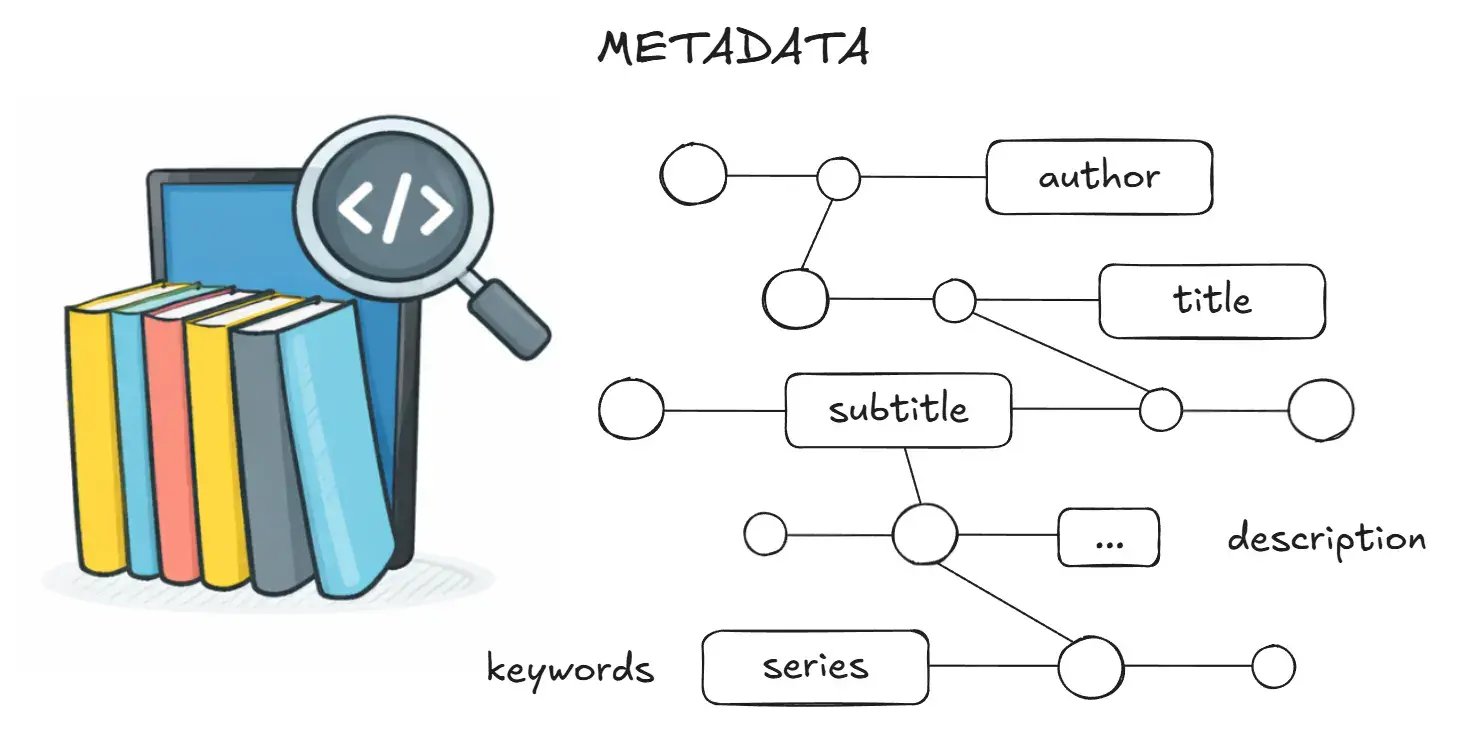
Metadata enrichment extracts and structures key attributes from documents, such as author, title, keywords, descriptions, and other contextual fields.
Recognizing metadata enrichment as a first-class AI capability is a necessary step to achieve more expressive, efficient, and intelligent document retrieval systems. However, enrichment alone does not change how relevance is computed. The key challenge lies in how enriched metadata is incorporated into retrieval and ranking mechanisms. Aspect Search addresses this gap by enabling multi-aspect relevance computation, where enriched metadata actively shapes similarity rather than acting as an external constraint [2].
AI-Enriched Metadata in Practice
Common examples of enriched metadata include automatically generated summaries, topic or domain classification, keyword extraction, language detection, named-entity recognition, and sensitivity or compliance labels. On their own, these attributes can act as filters, which can make retrieval more precise but also more restrictive if applied rigidly.
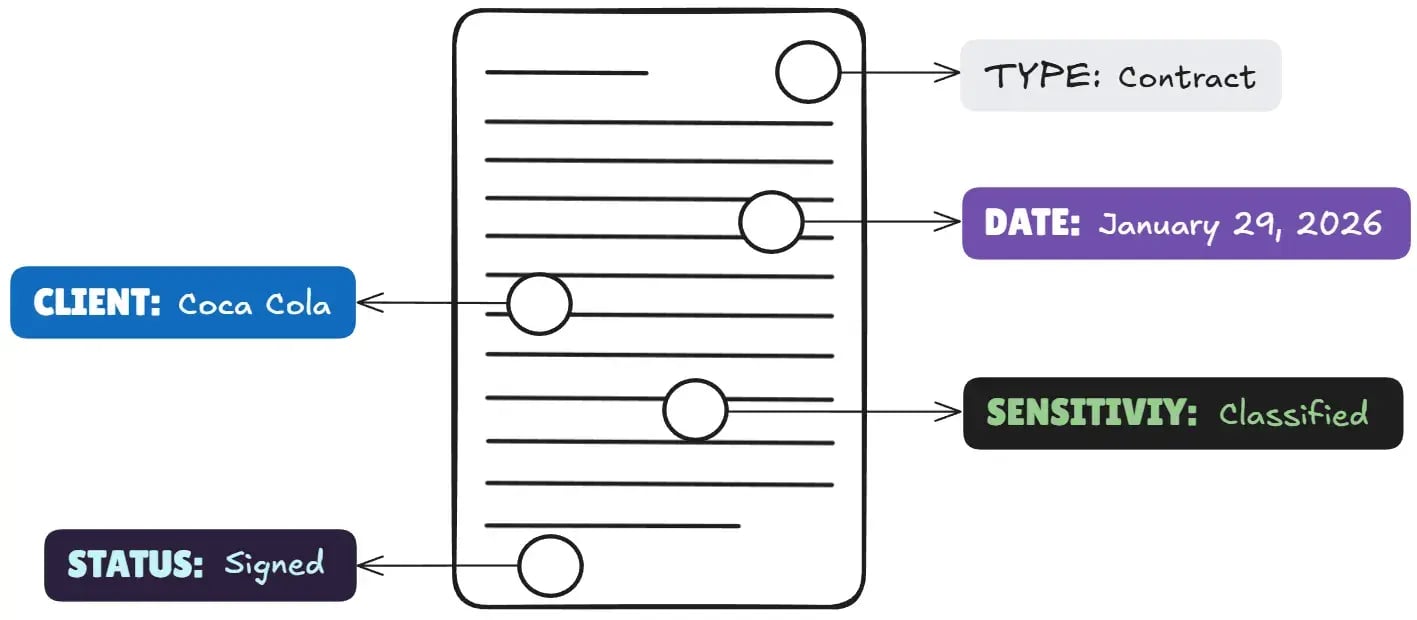
Example of AI-driven metadata extraction, where models identify and structure key attributes from unstructured text files.
AI-driven enrichment processes are scalable and can be applied consistently across large document repositories. When guided by domain-specific prompts or fine-tuned models, they can also become domain-aware, producing metadata that aligns with organizational vocabulary and policies. Industry platforms increasingly expose these capabilities as part of knowledge enrichment, reinforcing their role as operational components of modern systems [2].
Current Limitations
Despite these advances, metadata enrichment is often implemented as a secondary process. This means that attributes are typically stored separately and used primarily for display or filtering, rather than being integrated into the core retrieval and ranking logic. For example, a user may search for “signed contracts with Coca-Cola,” while the repository only contains an unsigned draft agreement with Coca-Cola. Traditional hard filters would exclude the document entirely. A relevance-based model, however, can still surface it as highly related, reflecting likely user intent rather than rigid metadata matching. In most architectures, this insight is stored as enriched metadata but it still does not influence similarity scoring during retrieval. As a result, relevance is still approximated through heuristics instead of being computed directly.
The real value of enriched attributes emerges when they become part of the relevance computation itself. In an Aspect Search approach, enriched metadata can be assigned a controllable semantic weight, allowing structured attributes to influence similarity scoring alongside textual content rather than acting only as constraints.
Aspect Search: When Enrichment Becomes Relevance
Aspect Search bridges this gap by transforming meaningful document properties into vectors and combining them with semantic embeddings into a single representation. This produces a unified, weighted, multi-dimensional similarity model that runs in a single query and computes relevance directly rather than approximating it.
Therefore, the model developed by Aspected repositions metadata enrichment from a supporting function to a foundational design principle. In Aspect Search, both original metadata and AI-enriched attributes are treated uniformly as intrinsic properties that define a document alongside its textual content.
Instead of maintaining a strict distinction between raw metadata and derived signals, Aspects Search incorporates all document attributes into a unified processing pipeline. Each aspect, whether system-generated, user-defined, or AI-enriched, is transformed into a structured representation that captures its real-world semantics.
By embedding enriched metadata directly into the document representation, Aspect Search ensures that attributes such as summaries, classifications, and timestamps contribute to indexing and retrieval. Similarity calculations therefore consider not only semantic content but also contextual and structural properties. The result is more expressive, efficient, and explainable retrieval behavior.
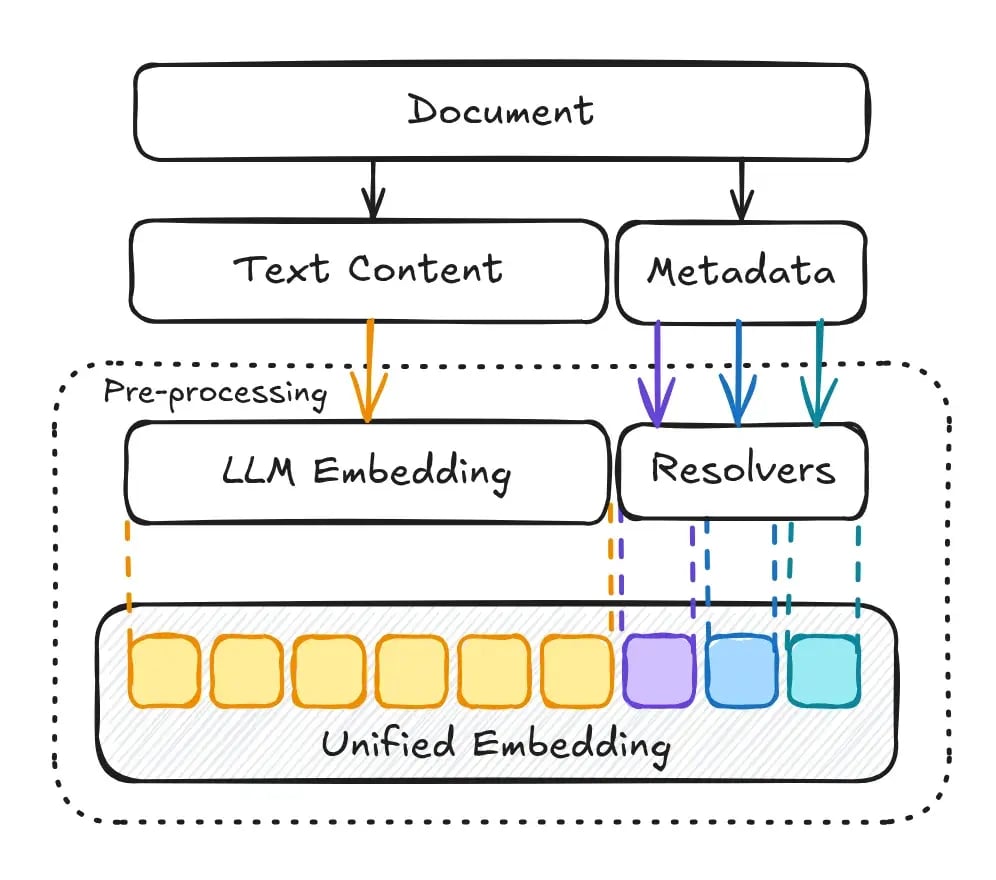
Simplified illustration of how documents are transformed into a unified multi-aspect embedding in Aspect Search.
As a consequence, metadata enrichment is elevated from a background optimization to a visible source of value. Users benefit from improved discovery, more relevant related-document suggestions, and retrieval workflows that better reflect real-world usage patterns. From a technical perspective, Aspected demonstrates how metadata enrichment can be operationalized as a scalable, first-class capability within AI-driven information systems.
The Future of Metadata Enrichment Technology
Artificial Intelligence systems are evolving rapidly, and metadata capabilities are evolving along with them. Recent advances in LLMs have made metadata enrichment far more practical and expressive than before, but this capability is still in its early stages. Today’s enrichment techniques only scratch the surface of what will be possible as models become more accurate, more domain-aware, and easier to adapt to real-world use cases. There are several trends that are expected to play an important role in its future development.
In the first place, enrichment processes are becoming increasingly context-aware, adapting derived metadata to organizational domains, regulatory environments, and user roles. As LLMs improve, they are better able to take context into account, producing metadata that aligns more closely with how organizations actually work rather than relying on generic labels. Second, enrichment is moving toward continuous and incremental models, where metadata is updated as documents evolve. This allows metadata to stay relevant over time instead of becoming outdated as content changes. Third, there is a growing emphasis on explainability and traceability, ensuring that enriched attributes can be understood, audited, and trusted, particularly in regulated environments.
Finally, with the arrival of enriched metadata, a better integration with retrieval models becomes essential. As demonstrated by Aspected, enriched attributes reach their full potential only when they directly influence relevance computation, reinforcing their role as a core component of intelligent retrieval systems and providing the mechanisms needed to use them effectively.
If you are exploring how to build retrieval systems that fully leverage AI-enriched metadata, you can read our previous deep dive on the Aspected architecture, or visit http://aspected.com to learn more.
Team @ Aspected
References
[1] Europeana. (2025). Semantic enrichment.
Semantic enrichments — Europeana Knowledge Base — Confluence
[2] Hyland. (2025). AI-ready content starts here: Introducing knowledge enrichment.
AI-Ready Content Starts Here — Introducing Knowledge Enrichment