
Share this
by Aran Montero Salvadó on Apr 30, 2026, 6:54:56 PM
How context-aware retrieval helps enterprise AI find the right documents by combining content and context in a single representation.
TL;DR
Enterprise document retrieval rarely depends on content alone. Instead, file relevance is shaped by context: when a document was created, who it is for, whether it is valid, and how it relates to ongoing work. Traditional vector search systems handle this context through filters and additional search pipeline stages, which increases complexity and often degrades real relevance.
Aspected approaches this differently. Built around the Aspected Database, a context-aware retrieval engine for AI systems, it encodes both content and context into a unified representation. This allows a single query to retrieve documents that are not only semantically similar but also aligned across time, domain, role, and other constraints, without requiring multi-stage pipelines.
This article analyzes a real enterprise retrieval use case to demonstrate how this approach improves existing systems, including already established RAG pipelines and enterprise search architectures. The search performance offered by the Aspected approach represents the next step toward greater retrieval efficiency.
The Problem: “Find documents like this” is never just about content
In enterprise environments, document retrieval is rarely a simple keyword or semantic search problem. A common workflow can look deceptively straightforward: a user opens a document and asks for related content. In practice, however, “related content” almost always includes implicit constraints.
To be more concrete, we can consider a field engineer working with a technical report. What they actually need is not just similar documents, but documents that match multiple contextual dimensions at once. They may be looking for:
-
Documents about the same topic or system
-
Created within a recent timeframe
-
Relevant to a specific project or customer
-
Valid under current operational guidelines
Traditional systems struggle to express this intent cleanly. Semantic search can retrieve similar text, but ignores a large part of the context. Filters are able to enforce constraints, but they do it so rigidly and outside the ranking process. As a result, developers often end up composing multiple queries, applying filters, and introducing reranking stages to approximate what should be a single retrieval operation. This is not just inefficient, it fundamentally limits how document relevance is expressed.
Enterprise Knowledge Systems
This limitation becomes particularly visible in enterprise copilots and knowledge assistants. In a recent enterprise deployment, we observed that field engineers rely on Microsoft Copilot to access technical documentation and maintenance procedures. The challenge is not the availability of information, but retrieving the right information for the specific situation.
Without structured retrieval, systems tend to produce generic or incomplete answers. For instance, when asked:
“How to configure system power options for optimal performance?”
A standard Copilot setup typically returns a broadly correct but generic answer, often missing system-specific configurations or operational nuances. The result is technically valid, but not actionable or practical in the given context.
With Aspected, the same query can retrieve information that is aligned not only in content but also in context, when those signals are available. For example, results can be:
-
Aligned with the correct system type (server vs. workstation)
-
Scoped to relevant product versions
-
Grounded in validated internal documentation
-
Structured according to operational procedures
This does not come from the system inferring context implicitly, but from how contextual signals are incorporated into retrieval. When context is provided (for example, through query parameters, system state, or document structure), the Aspected Database integrates it directly into the similarity computation. This achieves a more complete representation, making it easier for the LLM to find the correct information.
Because these attributes are not applied as hard filters, retrieval becomes more robust: relevant results are less likely to be excluded prematurely, which reduces the risk of missing relevant information when context is incomplete or imperfect. As a result, the system does not guess. It retrieves.
From Multi-Step Pipelines to Single-Query Retrieval
To understand the impact, consider a typical enterprise query:
“Find documents similar to this report, from last quarter, related to finance.”
In a traditional vector-based system, this requires multiple steps:
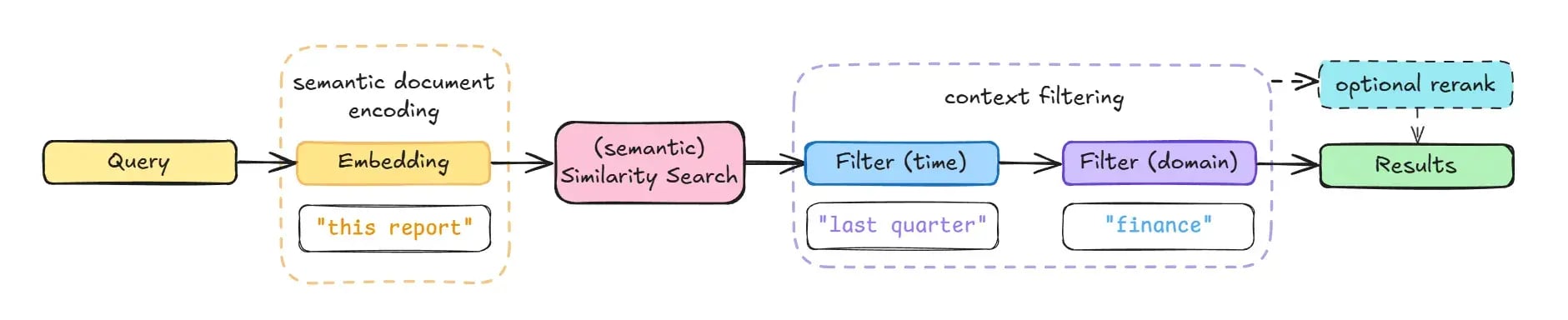
Traditional RAG pipelines require multiple sequential steps to incorporate context.
Each step introduces trade-offs. Filters may exclude relevant results too early. Post-filtering may require over-fetching. Reranking increases latency and complexity. In contrast, the Aspected Database enables a different approach. The same query becomes a single retrieval operation, where semantic similarity (document content), temporal proximity (last quarter), and domain alignment (finance) are encoded directly into the query representation.
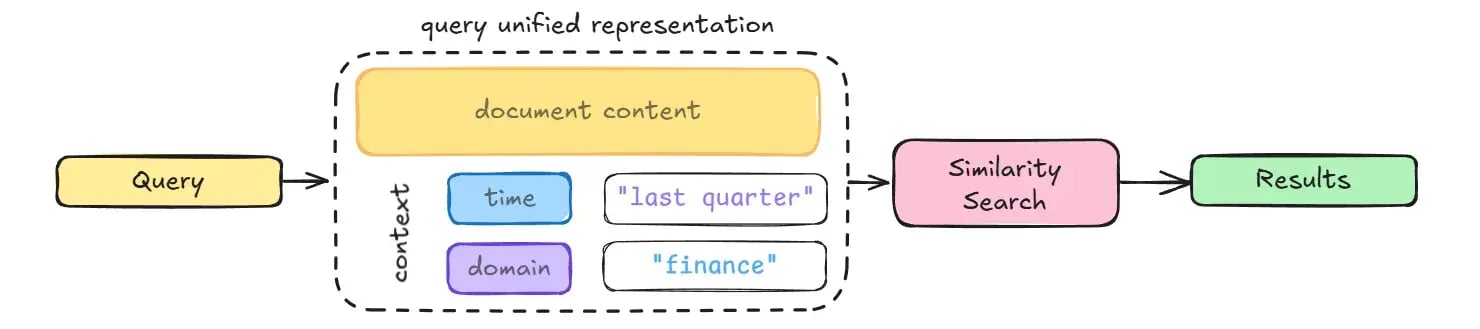
In the Aspect Database, context is part of the query representation, enabling more expressive retrieval without relying on hard filters.
Instead of restricting results after retrieval, these signals contribute directly to the similarity computation. This allows the system to return documents that best match the combined notion of relevance, without additional pipeline stages.
This example highlights a key difference: in Aspected, contextual signals are not applied after retrieval but encoded directly into the document representation. A document is modeled as a composition of multiple aspects, each capturing a different dimension such as semantic content, temporal attributes, domain context, or operational metadata. Each aspect is encoded as a vector, and these are combined into a unified representation used during retrieval.
From the system’s perspective, retrieval is still a similarity search. What changes is what similarity represents: instead of measuring only semantic proximity, it reflects a combination of content and context. This allows a single query to capture what would otherwise require multiple retrieval stages.
When This Matters Most
This approach is particularly valuable in scenarios where correctness depends on context, not just content. Examples include:
-
Field service and maintenance systems
-
Compliance and regulatory knowledge retrieval
-
Enterprise copilots and internal assistants
-
Customer support and troubleshooting systems
In these environments, retrieving a plausible answer is not sufficient. The system must retrieve the correct answer for the specific situation. Traditional systems struggle here because they rely heavily on semantic similarity, while many documents are often very similar in content (for example, manuals across different versions or systems). Without strong contextual signals, retrieval can easily surface the wrong variant of an otherwise relevant document.
Measurable Impact: Relevance and Efficiency
This shift has both qualitative and quantitative effects. From a relevance perspective, results become significantly more aligned with user intent. Documents are not just similar in content, but appropriate in context. This reduces the need for downstream correction by LLMs or users.
From a system perspective, the architecture becomes simpler and more efficient. By eliminating multiple retrieval stages, systems can reduce the number of queries required per request, avoid over-fetching and reranking overhead, and achieve overall better efficiency in retrieval pipelines. In practice, this leads to more predictable performance and easier system design, especially in large-scale enterprise environments.
Retrieval as a Multi-Dimensional Problem
It is important to understand that enterprise document retrieval is fundamentally a multi-dimensional problem. Textual content is only one part of relevance; context determines how that content should be interpreted and applied. Traditional vector search systems handle this by adding layers such as filters, rerankers, and orchestration on top of retrieval. Aspected takes a different approach by moving context into the retrieval layer itself.
Built around the Aspected Database, this enables a single-query retrieval model where both content and context are evaluated together. The result is a system that is not only simpler to operate, but also better aligned with how real-world knowledge is used. Ultimately, the goal is not to just retrieve documents with similar content but to retrieve the contextually correct ones.
If you are exploring new approaches to vector retrieval architectures, you can read our previous articles on Aspected, or visit http://aspected.com to learn more.
Team @ Aspected